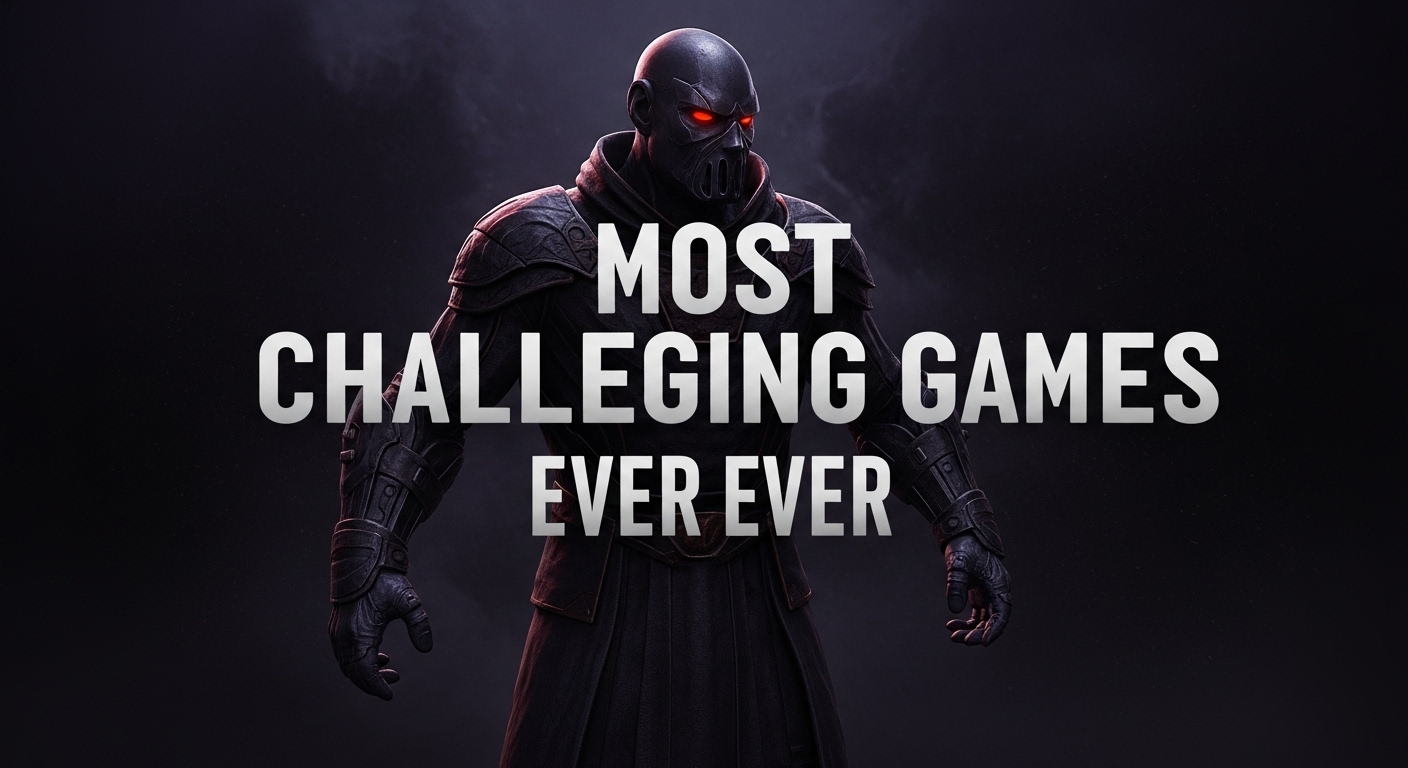
Video games have always been about more than just fun. They are experiences that test skill, patience, intelligence, and determination. While many games are designed to be accessible for casual players, there is a category of games that push players to their absolute limits. These are the most challenging games ever made, titles that demand relentless focus, razor-sharp reflexes, and the willingness to fail repeatedly before mastering them. Some are punishing due to their mechanics, others due to their unforgiving worlds, but all of them are unforgettable because of the sheer sense of accomplishment they offer once conquered. In this blog, we will take an in-depth look at the most difficult games across different generations and genres, exploring what makes them so uniquely demanding and why players continue to embrace the struggle.
Why Gamers Seek Challenging Experiences
At first glance, it may seem unusual that players would voluntarily subject themselves to near-impossible challenges. However, human psychology plays a big role here. The harder the struggle, the sweeter the victory. Games that are brutally hard provide a sense of achievement that cannot be matched by easier, more forgiving titles. Overcoming a seemingly insurmountable obstacle brings feelings of pride and satisfaction, while also creating memorable stories of perseverance. For many, beating a difficult game is not just entertainment but a badge of honor, proof of patience and skill. This is why the hardest games maintain cult followings and continue to be celebrated long after their release.
The Era of Classic Arcade Punishment
Long before consoles and PCs dominated the gaming landscape, arcades were the birthplace of gaming difficulty. Developers purposely designed arcade games to be punishing because more difficulty meant players would have to spend more coins to keep playing. Titles like Ghosts ‘n Goblins, Battletoads, and Contra are legendary for their relentless difficulty. Ghosts ‘n Goblins in particular is infamous, as players must beat the game twice in a row to see the true ending, all while surviving constant enemy waves and unforgiving platforming. These early classics set the foundation for gaming difficulty, creating an environment where only the most dedicated could claim victory.
Dark Souls and the Rise of Modern Hardcore Gaming
No discussion of challenging games would be complete without mentioning the Dark Souls series. Released by FromSoftware, Dark Souls redefined the modern concept of difficulty in gaming. It didn’t just rely on hard-hitting enemies or unfair obstacles but combined strategic combat, limited resources, cryptic storytelling, and oppressive worlds into an experience that required patience and learning. Each death served as a lesson, and progression was only possible through mastery. Dark Souls became so influential that the phrase “Souls-like” is now used to describe a whole genre of punishing games inspired by its formula. Its legacy proves that challenging gameplay, when done right, can reach mainstream success without sacrificing integrity.
Demon’s Souls: The Beginning of a Legacy
Before Dark Souls, there was Demon’s Souls. Released in 2009, it shocked players with its unforgiving design at a time when most mainstream games were becoming more accessible. Demon’s Souls demanded perfection, punishing even the smallest mistakes with death. Enemies could kill players in just a few hits, while bosses required precise timing and deep strategy. The atmosphere of loneliness and despair made the struggle even heavier. Although it initially received mixed reactions, it has since become a cornerstone in gaming history, proving that players craved challenge more than developers realized.
Sekiro: Shadows Die Twice and the Art of Precision
FromSoftware didn’t stop at Souls games. Sekiro: Shadows Die Twice introduced a unique combat system built around precise parries and lightning-fast reflexes. Unlike Dark Souls, where defensive play could still be viable, Sekiro demanded mastery of aggressive swordplay and constant timing perfection. Enemies were designed to push players into memorizing patterns, punishing hesitation with immediate death. Even experienced players found Sekiro to be a new level of frustration, yet its difficulty was praised for rewarding persistence and honing skills. Many consider it one of the hardest modern games ever released.
Cuphead and the Return of Classic Punishment
In 2017, Cuphead took the gaming world by storm with its stunning 1930s cartoon art style. However, behind its charming visuals was a brutal run-and-gun game that demanded precision and patience. Cuphead’s boss fights were relentless, filled with chaotic patterns and overwhelming attacks that left players barely a moment to breathe. Every stage was a test of pattern recognition, hand-eye coordination, and quick thinking. What made Cuphead especially difficult was that its cheerful presentation hid the fact that it was as punishing as the arcade games of the past. Beating Cuphead became a true test of endurance and skill.
Battletoads and the Infamous Speeder Bikes
Battletoads, released in 1991, remains infamous for one of the most frustrating levels in gaming history: the speeder bike stage. Players had to react within milliseconds to obstacles while traveling at breakneck speed, often leading to countless failures. The rest of the game was no less brutal, filled with cheap enemy placements and nearly impossible platforming. Battletoads cemented itself as one of the most unforgiving games ever created, with many players never making it past the early levels. Despite its difficulty, it is fondly remembered as a true symbol of old-school gaming punishment.
Ninja Gaiden: Precision and Punishment
The Ninja Gaiden series, especially the original NES trilogy and the later 2004 reboot, is another benchmark in gaming difficulty. The NES titles were notorious for their relentless enemies, cheap respawns, and brutal bosses. Missing a single jump could undo entire levels of progress. The 2004 reboot carried on the legacy, introducing lightning-fast combat that required reflexes and accuracy unlike anything else at the time. Ninja Gaiden’s challenge came not from randomness but from expecting absolute perfection from its players, making it one of the most respected and feared series in gaming history.
I Wanna Be The Guy and the World of Fan-Made Punishment
Not all difficult games come from major studios. I Wanna Be The Guy, a fan-made platformer, gained notoriety for being one of the most deliberately unfair games ever made. It was filled with traps that defied logic, such as platforms that disappeared, enemies that appeared out of nowhere, and spikes that killed players instantly. Unlike traditional games that gave players a fair chance, this game thrived on trolling and surprising players with unexpected deaths. Beating it required memorization, extreme patience, and a willingness to embrace absurd difficulty.
Super Meat Boy and the Art of Precision Platforming
Super Meat Boy is another game that stands out for its punishing yet fair difficulty. Every level is designed with extreme precision, requiring perfect timing and split-second decisions to complete. Death comes quickly and often, but the instant respawn feature makes it addictive to keep trying again and again. With hundreds of levels that become progressively harder, Super Meat Boy tested the limits of player patience and skill while still feeling rewarding to master. It remains one of the most celebrated indie games for its challenging but fair design.
Contra and the Origins of Run-and-Gun Punishment
Contra, a classic run-and-gun shooter, is a staple in the conversation about gaming difficulty. Released in 1987, it gave players only a few lives to survive relentless enemy waves and overwhelming boss battles. One mistake could cost everything, and memorizing patterns was essential. Contra’s “30 lives code” became legendary, highlighting just how unforgiving the game was in its natural state. Despite its difficulty, it was highly popular, and beating Contra without cheats is still considered a major accomplishment among retro gamers.
Monster Hunter and the Grind of Precision Combat
The Monster Hunter series might not appear as traditionally punishing as other games, but it is one of the most demanding in terms of patience, skill, and strategy. Battles against giant monsters could last upwards of an hour, requiring careful resource management and mastery of weapon systems. One mistake could undo an entire fight, forcing players to start from scratch. Success required not just individual skill but also teamwork in multiplayer hunts. Its challenging nature built a passionate fanbase that thrives on the thrill of the hunt and the satisfaction of victory after countless failed attempts.
Elden Ring: Expanding the Challenge to Open Worlds
Elden Ring, FromSoftware’s most ambitious project, took the DNA of Dark Souls and expanded it into an open world. While the game offered more freedom in exploration, it did not reduce the level of difficulty. Powerful enemies roamed the lands, capable of destroying unprepared players in seconds. Boss fights remained brutally demanding, requiring mastery of mechanics and patience. However, Elden Ring balanced its challenge by allowing players to choose different approaches, giving them room to adapt without compromising the sense of achievement. It stands as one of the most celebrated examples of how challenging games can thrive in the modern era.
The Psychological Effect of Difficult Games
Beyond gameplay mechanics, one of the reasons difficult games resonate with players is the psychological impact. These games create an emotional journey filled with frustration, despair, determination, and finally triumph. The repeated cycle of failure and success mirrors real-life struggles, giving players a sense of accomplishment that extends beyond the game itself. This is why people proudly share stories of beating tough games, creating communities built around shared hardship and victories. The bond between player and game becomes stronger when the path to success is filled with genuine struggle.
Why Difficulty in Gaming Will Never Fade
While the gaming industry continues to expand and cater to wider audiences, difficult games will always hold a special place. They may not appeal to everyone, but they provide an experience that no easy game can replicate. As technology advances, developers continue to find creative ways to challenge players, from complex combat mechanics to puzzle-heavy experiences that require deep thinking. With every new generation, there will always be players who crave the thrill of pushing themselves to the limit, ensuring that the legacy of difficult games lives on.
Conclusion: The Beauty of Struggle in Gaming
The most challenging games ever made are not just about frustration; they are about growth, perseverance, and triumph. Titles like Dark Souls, Battletoads, Ninja Gaiden, Cuphead, and countless others have cemented themselves in history because they dared to push players beyond their comfort zones. They remind us that true achievement comes from overcoming obstacles, no matter how insurmountable they may seem at first. For gamers, the struggle is part of the beauty, and beating a truly hard game becomes a story worth telling for years.