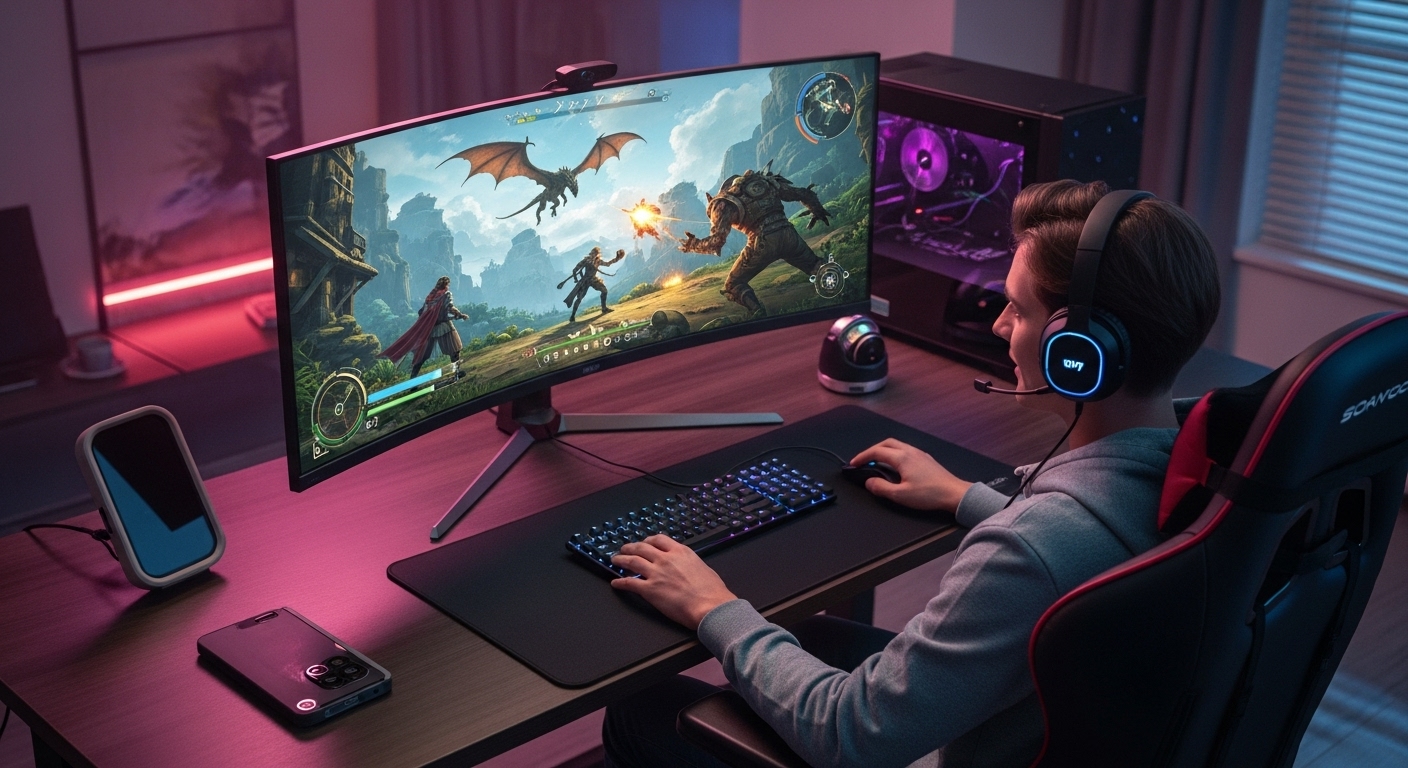
Gaming has come a long way since its humble beginnings in the 1950s, transitioning from basic pixelated screens to fully immersive virtual realities. What once started as a simple form of entertainment has evolved into a global cultural phenomenon. The growth of gaming has transformed it from an underground hobby to a mainstream pastime enjoyed by millions worldwide. In this post, we will take a deep dive into the journey of gaming, exploring its origins, key developments, technological advancements, and the impact it has had on society.
The Humble Beginnings of Gaming
The earliest known video game is often credited to William Higinbotham, a physicist who created Tennis for Two in 1958. This simple game allowed two players to hit a ball back and forth on a screen, creating the foundation for future video game development. However, the first commercial video game that hit the market was Pong, released by Atari in 1972. This two-player arcade game, where players controlled paddles to bounce a ball back and forth, became an instant success and laid the groundwork for the gaming industry as we know it.
The late 1970s and early 1980s saw the rise of arcade games. Titles like Space Invaders, Pac-Man, and Donkey Kong became cultural icons, marking the first golden age of gaming. These games were simple yet addictive, offering players an escape into digital worlds filled with challenges and competition. The arcades became social hubs where players gathered to test their skills, share experiences, and celebrate high scores. However, despite the success of arcade gaming, it was home consoles that would revolutionize the industry and bring gaming into the hearts of millions of homes.
The Console Revolution: Bringing Games to the Living Room
The early 1980s also marked the beginning of the home console era, with the launch of the Atari 2600. This was one of the first video game consoles to use interchangeable cartridges, allowing players to switch between different games on a single machine. Despite its commercial success, the industry suffered a major setback with the video game crash of 1983. Many companies overproduced games and consoles, leading to market saturation and a decline in interest. This crash nearly destroyed the industry, but the emergence of Nintendo and the introduction of the Nintendo Entertainment System (NES) in 1985 revived gaming.
Nintendo’s NES ushered in a new era of gaming, both in terms of hardware and game design. Iconic titles like Super Mario Bros., The Legend of Zelda, and Metroid set the bar for gameplay and storytelling, introducing players to expansive worlds, complex characters, and innovative mechanics. The success of the NES also spurred the development of Sega’s Genesis console and other competitors, leading to what is often referred to as the “console wars” of the 1990s.
The Rise of 3D Graphics and the Shift to the Next Generation
As technology improved, the need for more powerful hardware to support increasingly complex games became apparent. The next major leap in gaming came with the introduction of 3D graphics. Sony’s PlayStation (released in 1994) and the Nintendo 64 (released in 1996) were two of the first consoles to offer true 3D rendering capabilities, enabling a new generation of games that were far more immersive than anything players had experienced before.
Titles like Super Mario 64 and Final Fantasy VII took advantage of 3D environments to create dynamic and engaging experiences. For the first time, players could explore expansive 3D worlds, with the camera and character movement creating a level of immersion that had previously been unimaginable. This shift in gaming technology allowed developers to create more detailed and visually stunning games, and it marked the beginning of the transition to open-world gaming, which would later become a dominant genre.
The rise of 3D graphics also saw the debut of powerful gaming consoles, including the Sony PlayStation 2 and the Microsoft Xbox. These platforms, along with their respective game libraries, pushed the boundaries of what was possible in terms of gameplay mechanics, graphics, and storytelling.
The Online Gaming Boom
As gaming technology advanced, the internet also began to play a significant role in shaping the future of gaming. The late 1990s and early 2000s saw the rise of online gaming, with titles like Quake and Diablo II allowing players to connect with others across the globe. The online gaming experience added a new dimension to video games, as players could now compete against or cooperate with others in real-time, no longer limited to playing with friends and family in the same room.
The launch of Xbox Live in 2002 marked a major milestone for online gaming, providing a subscription-based service that enabled players to access multiplayer experiences and download additional content. World of Warcraft (released in 2004) became one of the most influential online games of all time, with millions of players creating characters and exploring a vast online world together. This era also saw the rise of competitive gaming and esports, which would go on to become a multi-billion-dollar industry in its own right.
Mobile Gaming and the Democratization of Play
With the advent of smartphones, gaming became more accessible than ever before. The introduction of the iPhone in 2007 marked the beginning of the mobile gaming revolution. Thanks to its powerful hardware and user-friendly interface, the iPhone allowed developers to create games that could be played on the go, making gaming more ubiquitous than ever before.
Games like Angry Birds, Candy Crush Saga, and Pokémon GO became cultural phenomena, attracting millions of players from all walks of life. Mobile gaming democratized play, allowing anyone with a smartphone to enjoy gaming without the need for expensive consoles or high-end PCs. The success of mobile games also spurred the rise of free-to-play models, in which games were available for free, but players could purchase in-game items or upgrades. This model has become increasingly popular, generating substantial revenue for developers while maintaining accessibility for players.
Virtual Reality: The Future of Gaming?
In recent years, virtual reality (VR) has emerged as one of the most exciting frontiers in gaming. VR allows players to fully immerse themselves in digital environments, offering a level of interactivity and presence that traditional gaming experiences cannot match. VR headsets like the Oculus Rift, PlayStation VR, and HTC Vive have made it possible for players to physically move within virtual spaces, interact with objects, and experience gaming in a more visceral way.
Games like Beat Saber, Half-Life: Alyx, and The Walking Dead: Saints & Sinners have demonstrated the potential of VR to create deeply immersive experiences. The future of VR gaming looks bright, with advancements in hardware and software continuing to push the boundaries of what is possible. As VR technology becomes more affordable and accessible, it is expected that gaming will continue to evolve in ways we can only begin to imagine.
The Social and Cultural Impact of Gaming
Gaming has always been more than just entertainment; it has also had a profound impact on social and cultural dynamics. Multiplayer games and online communities have allowed people to connect and form friendships across geographical boundaries. Games like Fortnite, League of Legends, and Minecraft have become platforms for social interaction, where players can collaborate, compete, and share experiences in a shared virtual space.
The rise of streaming platforms like Twitch and YouTube has further amplified the social aspect of gaming, with millions of people tuning in to watch others play, learn new strategies, or simply enjoy the entertainment value of live gameplay. Streamers and content creators have become influential figures, with some achieving celebrity status and building communities around their content.
Gaming has also been a medium for storytelling and artistic expression. Many modern games, such as The Last of Us, Red Dead Redemption 2, and Journey, explore complex narratives, emotional depth, and philosophical themes, proving that games can be as impactful and thought-provoking as any other form of art.
The Future of Gaming: What’s Next?
As technology continues to advance, the future of gaming promises even more exciting developments. Cloud gaming, for example, is poised to change the way we access and play games. Services like Google Stadia, Xbox Cloud Gaming, and NVIDIA GeForce Now allow players to stream games directly to their devices, eliminating the need for powerful hardware and enabling a more seamless, accessible gaming experience.
Artificial intelligence (AI) is another area that will shape the future of gaming. AI can be used to create more responsive and dynamic worlds, where NPCs (non-playable characters) behave intelligently and adapt to player actions. This will lead to more immersive and challenging experiences, where the world feels alive and reactive to the player’s choices.
Finally, the integration of augmented reality (AR) with VR may lead to even more immersive gaming experiences. As AR and VR technologies continue to converge, players may soon be able to step into digital worlds that blend seamlessly with the real world, offering experiences that are both familiar and otherworldly at the same time.
Conclusion
Gaming has evolved tremendously over the past few decades, from its early days as a simple pastime to a complex and immersive form of entertainment enjoyed by millions of people worldwide. The future of gaming holds endless possibilities, with new technologies, innovative gameplay experiences, and an ever-growing global community. Whether you’re a casual gamer, a competitive player, or simply someone who enjoys the artistry of video games, there’s no denying that gaming has become a central part of modern culture. The journey of gaming is far from over, and as technology continues to push the limits of what is possible, the next chapter in this incredible evolution promises to be even more exciting than the last.